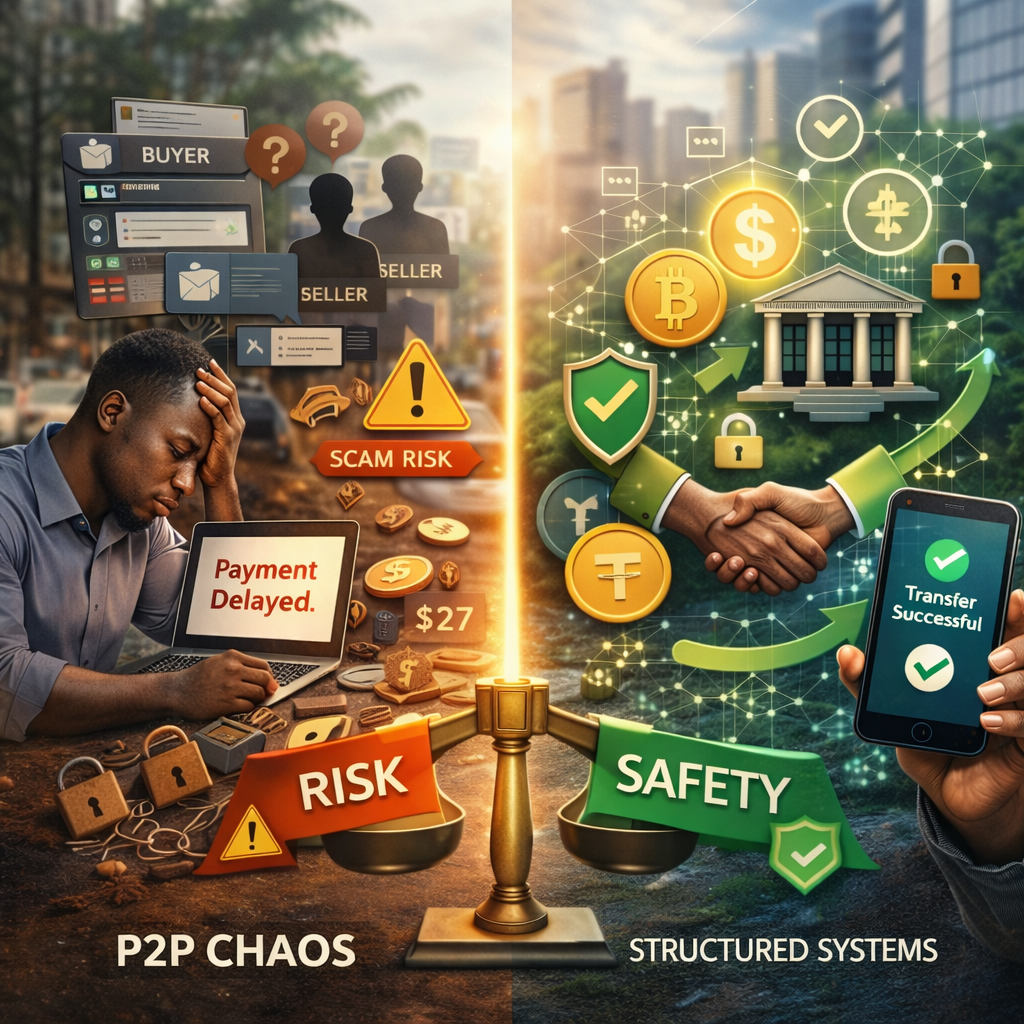
For years, peer-to-peer (P2P) trading has been sold as freedom.
No middlemen.
Fast deals.
Flexible rates.
Direct transactions.
And in the early days, it felt like a solution.
Today, it’s becoming one of the most dangerous habits in digital finance.
Not because people are bad.
But because the environment has changed.
The Scam Wave Nobody Wants to Admit
Every week, more people lose money through:
- Fake buyers and sellers
- Reversed payments
- Stolen cards and disputed funds
- Screenshots that look real but aren’t
- Middlemen who disappear when something goes wrong
- Deals that “almost” work — until they don’t
Most of these stories never make the news. They stay in DMs, group chats, and quiet warnings between friends.
But the pattern is clear:
As digital value grows, scam sophistication grows with it.
The same openness that made P2P popular is now what makes it easy to exploit.
The Brutal Truth: Trust Is No Longer Enough
P2P works on one fragile assumption:
That the person on the other side will behave.
Sometimes they do.
Sometimes they don’t.
And when they don’t, there is often:
- No enforcement
- No recovery
- No real investigation
- No guaranteed protection
In modern digital finance, hope is not a security system.
Why “Just Be Careful” Is No Longer a Strategy
People often say:
- “Just use escrow.”
- “Just trade with trusted people.”
- “Just be smart.”
But scams don’t target careless people anymore.
They target experienced people with better tools, better fakes, and better timing.
When the system itself has no structure, even smart users eventually get caught.
This is not a user problem.
It’s a system design problem.
The Shift That’s Already Happening
Around the world, finance is moving away from:
- Informal deals
- Screenshot-based trust
- Chat-based settlements
- And unverifiable promises
Toward:
- Structured processes
- Verifiable steps
- Controlled settlement flows
- And accountable systems
Not because people love bureaucracy.
But because scale requires safety.
Why Structure Is No Longer Optional
When you move:
- Small amounts → you can risk improvisation
- Big value → you need systems
When you serve:
- A few friends → trust is enough
- A growing market → trust must be engineered into the process
Structure does three things P2P cannot guarantee:
- It reduces uncertainty
- It limits points of failure
- It creates predictable outcomes
That’s not marketing. That’s infrastructure.
Where WaidTred Fits Into This New Reality
WaidTred was built for this exact moment.
Not as another “find a buyer” platform.
Not as another chat-based deal flow.
But as a structured liquidity and conversion system.
Instead of asking users to gamble on counterparties, WaidTred focuses on:
- Defined transaction flows
- Clear conversion logic
- Controlled settlement steps
- And predictable delivery of value
The goal is simple:
Remove the need to trust strangers with your livelihood.
The Real Question People Should Be Asking Now
Not:
- “Can I find a better rate in P2P?”
But:
- “Can I afford one bad transaction?”
Because in today’s environment, one bad deal can erase months of work.
The End of the Old Way
P2P was a bridge.
Not a destination.
It helped people move when systems were missing.
But as value grows, the cost of informality grows even faster.
The future of digital finance will not be built on:
- DMs
- Screenshots
- Or “trust me bro” economics
It will be built on structure, verification, and reliable settlement.
The Only Way Forward
This is not about WaidTred versus P2P.
It’s about systems versus improvisation.
WaidTred represents a shift toward:
- Safer value movement
- Predictable outcomes
- And financial infrastructure that people can actually build on
In a world where scams are scaling faster than trust, structure is no longer a luxury.
It’s the only way forward.
Leave a Reply