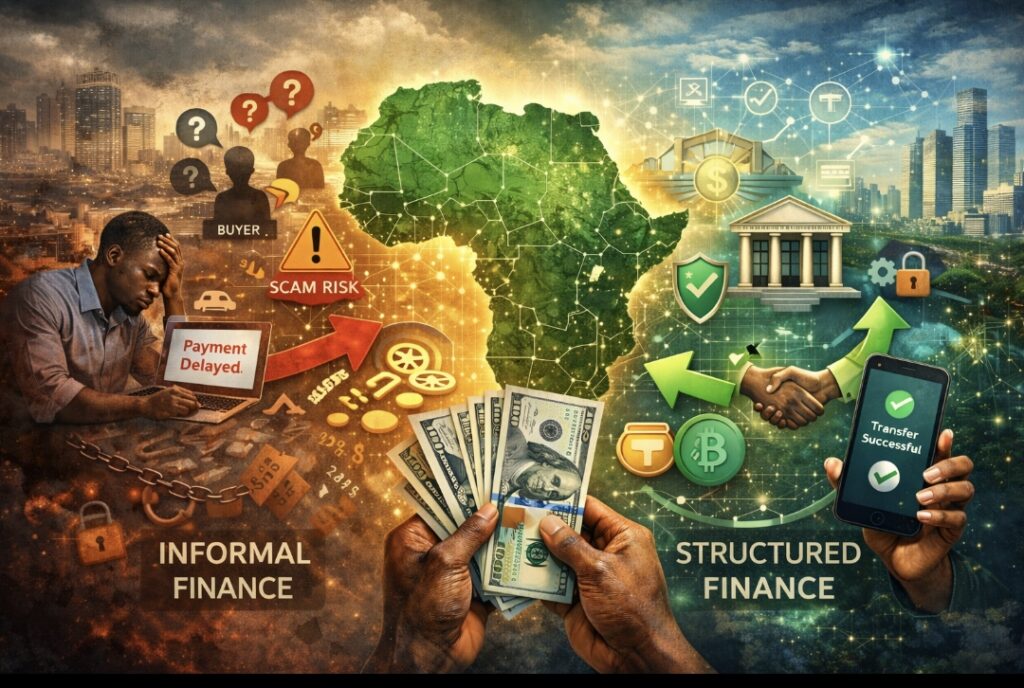
Across Africa, millions of people move money every day outside formal systems.
They trade peer-to-peer.
They rely on middlemen.
They use informal networks to convert value, receive payments, and send funds across borders.
On the surface, this looks like flexibility. In reality, it comes with a cost most people only discover after something goes wrong.
That cost is uncertainty.
When Money Moves Without Structure, Risk Follows
Informal finance exists for a reason.
People use it because official systems are often slow, expensive, or inaccessible.
But informal systems usually come with the same problems:
- No clear guarantees
- No consistent standards
- No reliable dispute resolution
- No transparency in pricing
- No real accountability when things fail
Most of the time, things work.
But “most of the time” is not how serious economies are built.
One failed transaction can mean:
- Lost savings
- Missed opportunities
- Broken trust
- Or months of recovery for a small business or freelancer
In a world where more people earn digitally and globally, uncertainty becomes a tax on growth.
The Quiet Truth: Value Moves Faster Than Trust
Today, value moves faster than ever:
- Crypto moves in seconds
- Digital payments move in minutes
- Online work crosses borders instantly
But trust still moves slowly.
Trust requires:
- Clear rules
- Predictable processes
- Verifiable outcomes
- And systems that don’t depend on personal promises
When money moves faster than trust, people fill the gap with improvisation.
And improvisation is useful — but it’s not scalable.
Why Structure Changes Everything
Structure is not about making things complicated.
It’s about making things reliable.
A structured financial system focuses on:
- Clear steps from start to finish
- Defined roles and responsibilities
- Transparent conversion logic
- Consistent settlement methods
- And predictable outcomes
This is how:
- Businesses plan
- Freelancers grow
- Families depend on cross-border support
- And economies become stable instead of fragile
Structure turns hope into confidence.
Where WaidTred Comes In
WaidTred was not built to be just another trading desk or exchange point.
It was built around a different idea:
Cross-border value movement should be engineered like infrastructure, not treated like a gamble.
Instead of relying on random P2P arrangements, WaidTred operates as a structured liquidity and conversion hub that connects:
- Digital value (like USDT and crypto)
- Alternative value (like gift cards)
- And real-world payouts (like local bank transfers)
The goal is simple:
Turn complex, risky value movement into a clear, managed process.
Not hype.
Not shortcuts.
Not guesswork.
Just structure.
Why This Matters for the Future of Work in Africa
Africa’s digital workforce is growing fast.
More people are:
- Freelancing for global clients
- Selling digital services
- Trading online
- Building cross-border businesses
- Earning in non-local currencies
But if the financial layer stays unreliable, growth hits a ceiling.
You can’t scale:
- On uncertainty
- On fear of failed payouts
- On systems that only work “most of the time”
Reliable financial rails are not a luxury.
They are economic infrastructure.
The Real Shift That’s Happening
The real change is not just digital money.
It’s systemized money movement.
We are moving from:
- Trusting people → to trusting processes
- Improvisation → to infrastructure
- Survival tactics → to sustainable systems
This shift is what turns participation into prosperity.
Informal finance helped people survive.
Structured finance helps people build.
The future belongs to platforms that:
- Reduce uncertainty
- Increase reliability
- And make global value usable locally without drama
That’s the space WaidTred is designed to operate in.
Not as a shortcut.
Not as a gamble.
But as part of a new financial layer where structure, trust, and access finally move at the same speed as value.
Leave a Reply